Go private pay without losing the people you got into this work for.
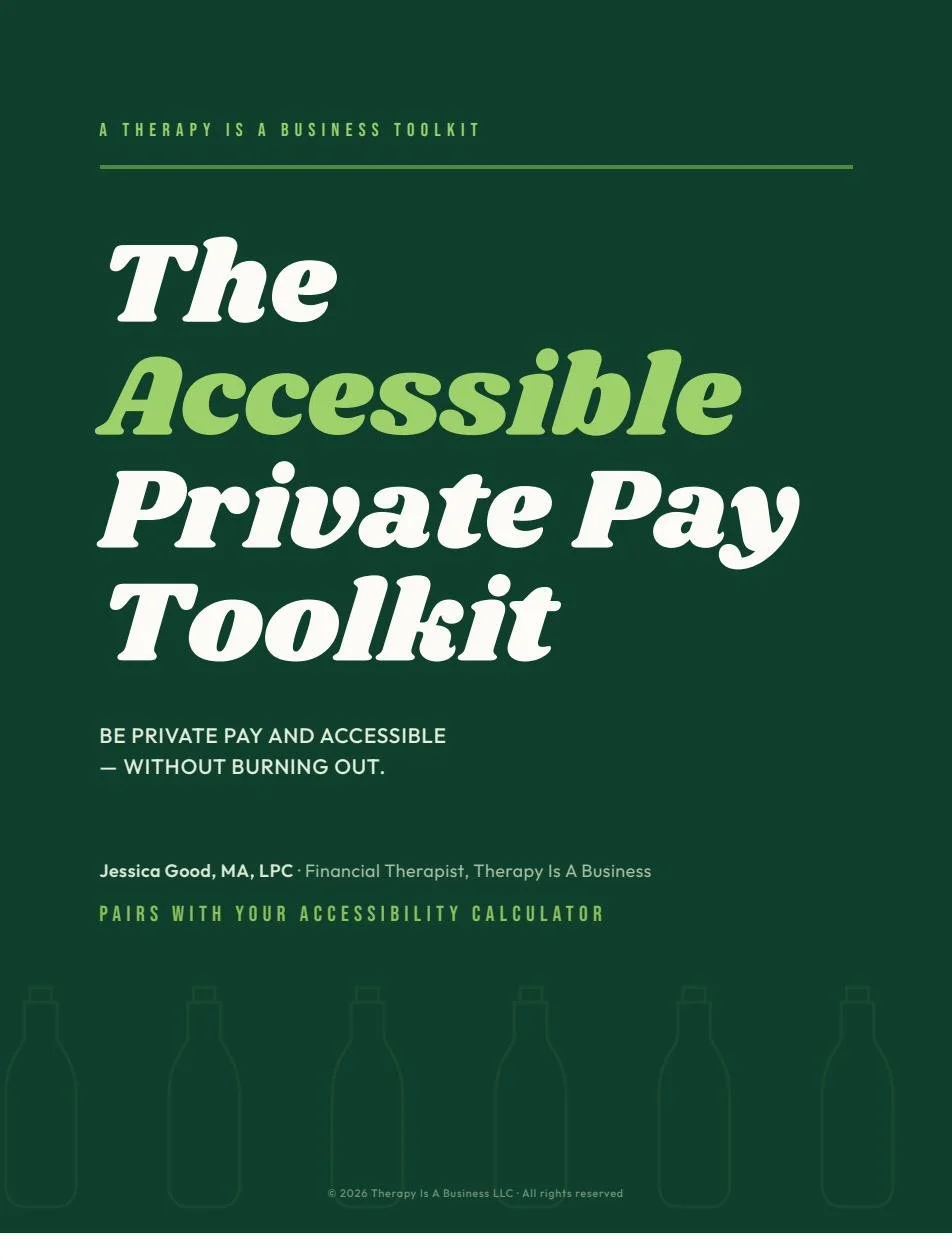
You don't have to build the math yourself. The calculator sets your rates from your real numbers, thirteen scripts hand you the words, and 58 pages walk you through every decision in between.
- Done-for-you rate calculator
- 58 pages
- 13 scripts
- 2 methods
- Instant access
Instant download. Opens in any PDF reader. Yours to keep.
I used this with my own clients before I sold a single copy.
A full operating manual, not a checklist with a nice cover.
The calculator will not let you price below what you need to earn.
You already know which version is yours
Maybe you're on insurance panels you've outgrown, watching reimbursements shrink while your caseload stays full, landing at midnight on the same conclusion as last year: private pay is the only way this becomes sustainable. But every time you get close, the same thought stops you cold. What about the people who can't pay? What about the clients you already love, the ones you'd lose the second you raised your fee? So you stay. Underpaid, fully booked, telling yourself you'll deal with it in the fall.
You did the values part the only way you knew how. You said yes. To the client who asked for a break, then the next one, then the one after that. No cap, no floor, no rule. So now you're carrying eight reduced-fee clients against a handful paying full fee, you're not sure how it tipped that way, and you feel something you don't love admitting when those sessions land on your calendar. Resentment. Because that is what giving from depletion gets you.
You've got a client on your lowest rate who just got back from a week in Cabo. You set that rate to protect people who genuinely couldn't afford care, you're pretty sure this isn't that, and you've said exactly nothing, because bringing it up feels worse than eating the loss. So you eat it. Month after month.
Underneath all three is the same thing. You were handed a value, be accessible, and never handed a structure to deliver it. So accessibility became something you give away one guilty exception at a time, until the practice that was supposed to serve everyone is the one running on fumes.
You've been piecing this together with half a map
The mindset folks hand you a feeling. Charge your worth, feel the fear and do it anyway, here's a worksheet on abundance, and you close the tab still not knowing what to actually charge.
The numbers folks hand you a spreadsheet, which becomes useless the second the figure it spits out makes your stomach drop and you talk yourself down to something safer.
Nobody hands you both at once. And almost nobody handing out either one still sees clients, so they've never sat across from someone terrified of the bill the way you have. You've been doing this alone, with half a map.
Not anymore.
The calculator and the scripts
Two things take the two scariest parts off your plate.
The calculator
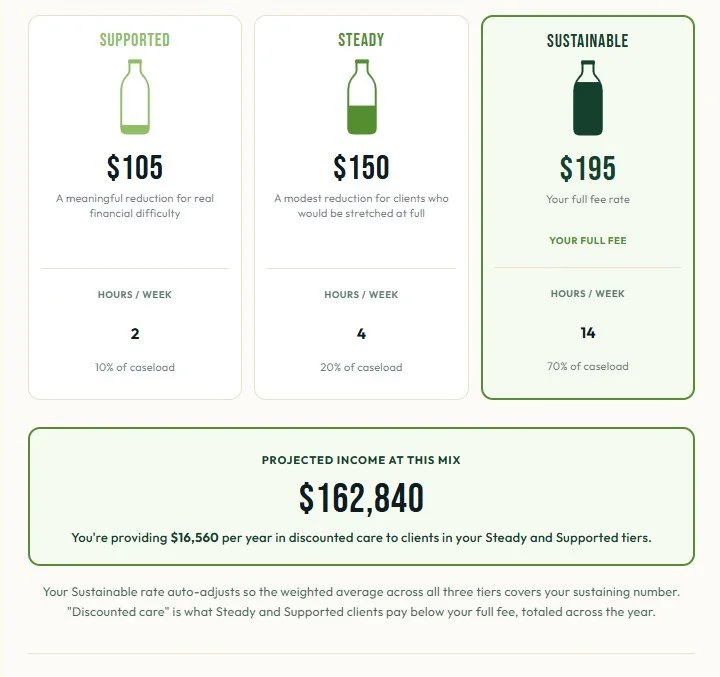
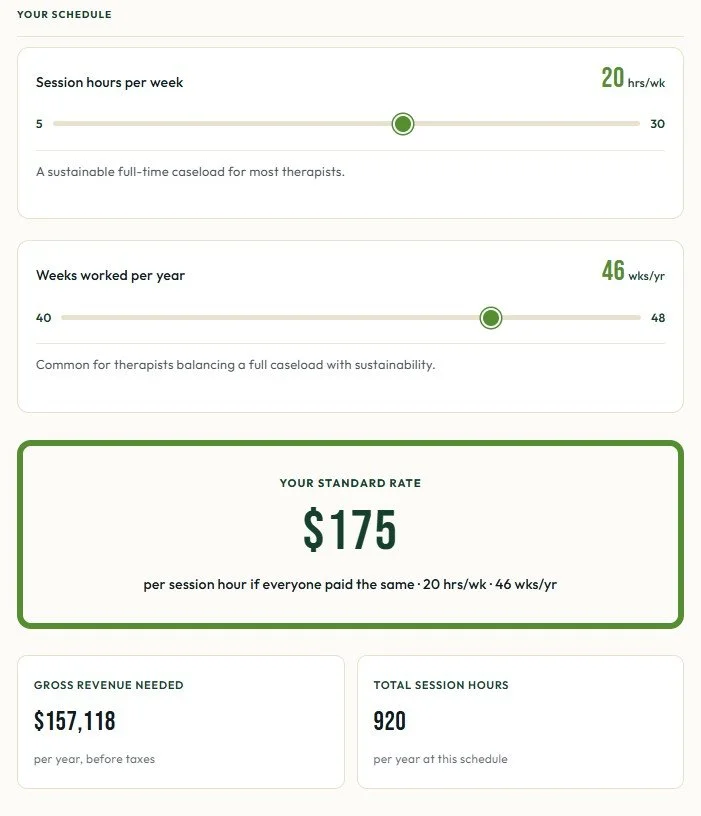
You feed it what your life and your practice actually cost, and it builds your pricing so you never drop below what you need to earn for the year. For a sliding scale, it works out how many people at each tier and at what price to keep you above your floor. For reduced-fee spots, you decide how generous to be, the rate and the hours, and it tells you the standard fee that generosity requires to stay survivable.
Try to set a number that sinks you, and it shows you in dollars exactly what that choice costs. It will not let you betray your own sustainability. It will not let you fail.
The scripts
Because a number is only worth something once you can say it out loud, and that is something most therapists dread. So you get the words for the exact moments you've been avoiding:
- The new client asking what you charge.
- Helping someone choose their tier without it getting weird.
- The client whose tier stopped matching the life they're actually living.
- The person who needs to move up and off a reduced-fee spot.
- The day you tell your current caseload the structure is changing.
Thirteen of them across both methods, written out, ready to make your own. You walk in knowing what to say instead of improvising through the fear.
Run a group practice? I built a calculator tab just for you, so you can set one accessible structure across your whole team.
The calculator settles the number. The scripts settle the words. And for the first time, you're not deciding either one alone in a moment of panic.
Get the toolkit — $47I reached out to Jessica with a desire to transition my practice to private pay with extended sessions. Jessica helped me to organize my thoughts and, importantly, stop underselling myself. The process felt forward-moving, clarifying, and absolutely worth my time.Tiffany Thomas, LMHC, Iowa
Tiffany worked with me one-on-one. The thinking behind this toolkit is the same thinking she paid for.
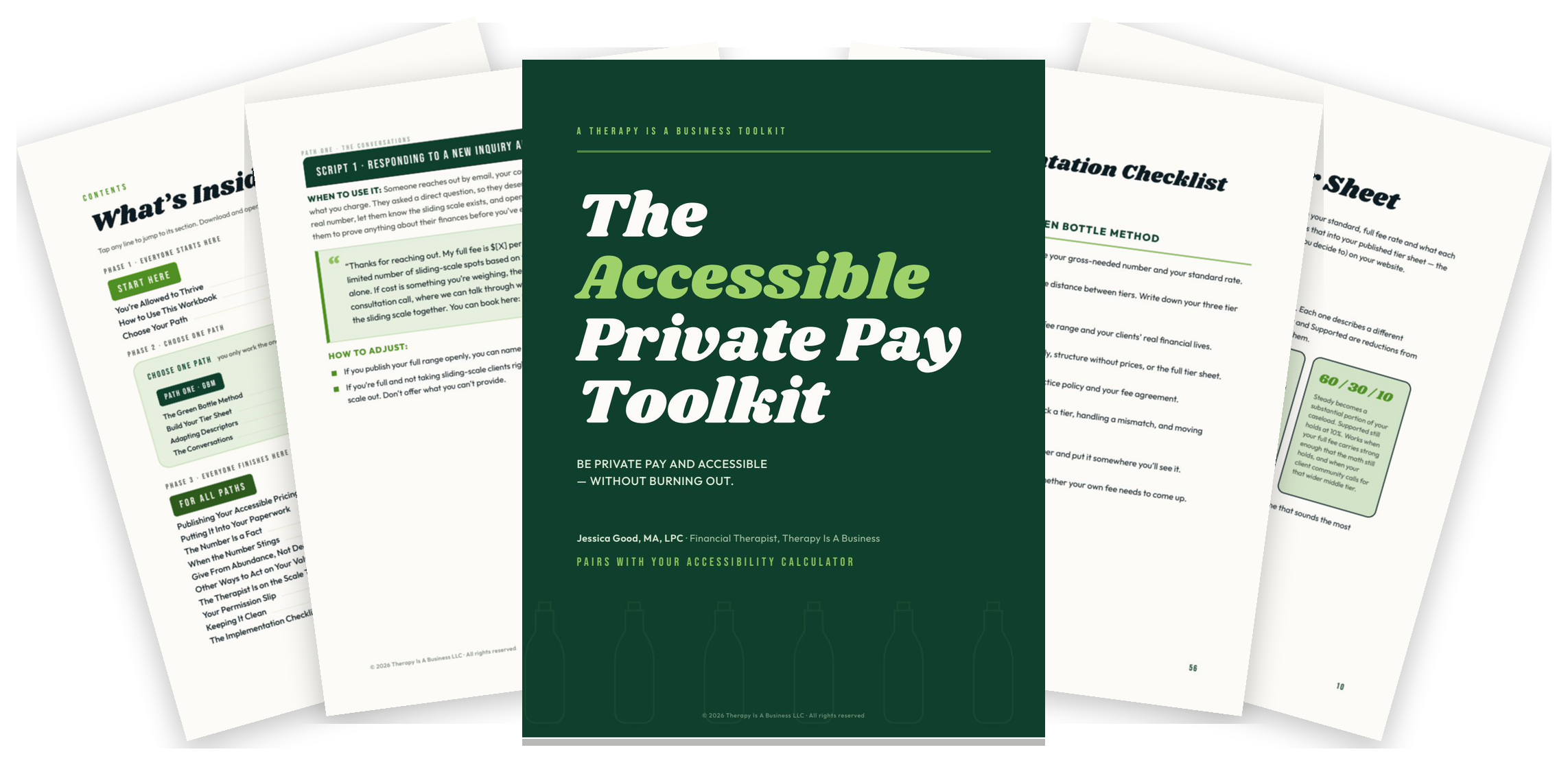
What 58 pages actually looks like
Enough to know exactly what you're getting before you spend anything.
Three phases, and you only work one path through the middle
The opening is for everyone: get grounded in what your practice actually costs and pick the model that fits how you work. The middle splits in two, a three-tier sliding scale or a set number of reduced-fee spots, and you build out only the one you chose. The last third is where both paths meet again: publishing your pricing, getting it into your paperwork, and the money work that makes any of it hold.
It ends with a checklist, not a cliffhanger
The last pages are a launch list for the path you picked: run your numbers, write your tier prices or your spot criteria, put the language into your policy and your fee agreement, decide what you publish, and book the yearly review. You close the file knowing what to do Monday morning, not wondering where to start.
All of it runs on one set of numbers. That is what the calculator is for.
The Accessibility Calculator
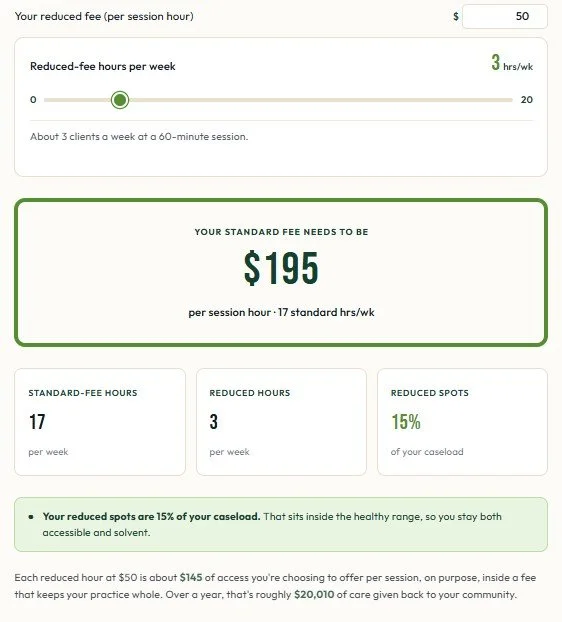
How much care did you give away last year?
Most therapists cannot answer that, and worry they aren't doing enough anyway. The calculator does that math for you. For the practice in these screenshots, three reduced-fee spots a week at $50 inside a $195 full fee came to this:
Care given back$20,010
in a single year
That is hard to argue with.
Get the toolkit — $47Everything else in the toolkit
The calculator and the scripts are the engine. These are the pieces that keep the whole thing holding together once it is running.
Two methods, plus the chooser
A three-tier sliding scale your clients self-select into, or a set number of reduced-fee spots you fill on your own terms, with the framework that tells you which one your practice can actually carry.
You build one path, not both, and you stop second-guessing the one you picked.
Client-facing language
Tier descriptors and reduced-fee criteria your clients read, built on financial lived experience rather than protected characteristics.
A copywriter charges more than this whole toolkit for one page of client-facing language.
Your paperwork, handled
Practice policy language, fee agreement language, and how to handle superbills and HSA or FSA payments.
The pieces you would otherwise assemble from four Facebook threads and hope.
Legal and ethical guardrails
Good Faith Estimate, applying your policy consistently, licensing board questions, and where your own state's rules take over.
A map of what to ask, so you build it clean once instead of wondering for two years.
The money work that makes it stick
The Number Is a Fact, When the Number Stings, Give From Abundance Not Depletion, The Therapist Is on the Scale Too, and Your Permission Slip.
This is the part every spreadsheet leaves out, and the reason the spreadsheets don't work.
Price the first reduced-fee spot correctly instead of guessing, and this pays for itself in a single session. Set your standard fee $15 too low for a year, and it costs you more than a hundred times what this does.
Get the toolkit — $47You're allowed to thrive
Here's the part the guilt drowns out: being paid enough to keep your doors open is how you keep showing up to care at all. The most accessible therapist in your town is the one whose practice is still standing in ten years. A sliding scale built on real numbers lets you stay generous without going broke to do it.

A quick word before you decide
I'm a therapist who still sees clients, running EMDR intensives every week because I love the work. I'm also a financial therapist who knows money runs deep. I was so broke in my youth that I lived off of $1 burritos from Taco Bell after I watched my parents earn millions and lose all of it to patterns nobody ever helped them look at.
I did my money work so that I can hold both truths: I deserve a thriving wage and I want to keep working with people who need help. I built this inside my own practice, on my own clients, before I sold a single copy. And my clients thanked me for it. Fifty-plus hours went into building this toolkit, and there's nothing else like it on the market.
Jessica
Who it's for, and who it isn't
This is for you if
- You're switching to private pay and you want a path forward for people who can't pay full fee.
- You're already private pay and the sliding scale you cobbled together is drowning you.
- You're tired of winging the money parts of your practice and want solid ground under them.
- You're willing to look at your own money story, not just your clients'.
This isn't for you if
- You want permission to keep undercharging without changing a thing. The calculator will show you that cost in dollars.
- You only want a pep talk. There's math in here, and the math doesn't flatter. There's plenty of mindset work throughout, but it isn't blowing smoke. It's rooted in the numbers.
- You want a fill-in-the-blank template and nothing else. Half the work is the part where you look at yourself. We have to get real if we're going to be sustainable.
- You're certain you're already doing it all right. Save your $47.
Here's the deal
Let me be direct with you. I should charge more for this, and I'd tell a client to charge well above it for less. But this is the door into my work, and I'd rather it reach the people who've spent years undercharging themselves than sit behind a price that keeps them out. Consider it your first lesson in giving from abundance instead of depletion.
I can price it here because my own practice holds. So can yours.
The Accessible Private Pay Toolkit
$47
- 58-page fillable workbook
- The Accessibility Calculator
- 13 client scripts
- 2 complete methods
- Group practice tab
- Instant access
Instant download. Opens in Adobe Acrobat or Apple Preview. Yours to keep.
The objections I would raise if I were you
The first two are open because they are the ones almost everyone arrives with.
Is this just another coach's product?
Fair question, and you should be suspicious. Most people selling business advice to therapists stopped seeing clients years ago, if they ever did. I still run EMDR intensives every week. I built this inside my own practice, on my own caseload, before I sold a single copy. If it had not worked there, it would not be here.
My clients can't afford private pay. That's the whole problem.
This is the objection the toolkit exists for. Going private pay does not mean abandoning people. It means deciding on purpose who you can carry and at what rate, instead of deciding it one guilty exception at a time. The calculator shows you exactly what that generosity costs you in a year, and what standard fee makes it survivable.
If I raise my fee, I'll lose the clients I have.
Some, possibly. The workbook has scripts for telling your existing caseload the structure is changing, and for moving someone up and off a reduced rate without it getting strange. Most therapists lose fewer clients than they expect, and the ones who stay are paying a fee that keeps your door open for the next person who needs it.
I'm not good with numbers.
You do not have to be. You type in what your life and your practice cost each month, and the calculator does the rest. There is no formula to build and no spreadsheet to wrestle with. That is the entire reason it exists.
I already have a sliding scale.
Then the real question is whether it has a floor. Most do not. If you cannot say what your scale costs you per year, or what full fee it requires to hold, you are running it on hope. The calculator gives you both numbers in about twenty minutes.
$47 feels too cheap to be any good.
I thought about that. This is the entry point to my work, and I would rather it reach the therapists who have spent years undercharging themselves than sit behind a price that keeps them out. Price is a positioning decision, not a quality one. Fifty-plus hours went into building it.
What if I buy it and it sits in my downloads folder?
A real risk with any workbook. Two things help. The calculator hands you a usable number in the first sitting, so you get something out of it on day one. And the last pages are a launch checklist for the path you chose, so there is always an obvious next step rather than a blank page.
Is a sliding scale even legal? What about the Good Faith Estimate?
There is a section on applying your policy consistently, handling the Good Faith Estimate, and building your criteria on financial reality rather than protected characteristics. It also tells you which questions belong with your own attorney or licensing board, because those rules change by state and I am not going to pretend otherwise.
You can keep telling yourself you'll fix it later.
Or, you can spend twenty minutes with the calculator tonight and walk into next week with numbers that actually work, the words for the conversations you've been dreading, and a practice built to still be here in ten years. If this is you, this is the door.
Get the Accessible Private Pay Toolkit — $47