Why Marketing Advice Isn't Working for Your Private Practice
The difference between following a recipe and cooking to taste
If you're doing everything the marketing advice told you to do and your practice still isn't filling, you don't have a marketing problem. You have a strategy problem. Generic advice hands you a list of ingredients. Strategy is knowing what to make with them, for your practice, your money story, and the way your brain is wired.
There's a post that shows up in therapist Facebook groups every single week. Someone writes it worn out, a little defeated, usually late at night. "I'm doing everything. I built the website. I picked a niche. I'm on the directories. I post consistently. And my calendar still isn’t full."
Then I take a look. At the website, or the copy, or the intake page they linked. And within about thirty seconds, there it is. The big, glaring thing they walked past a hundred times, because they were standing too close to see it.
Here's the hard part, said with love. You can be doing “everything” and still not be doing it right.
The effort was never the issue. The effort is the most impressive part of the whole thing actually. The problem is that they took a stack of free advice built for someone else's practice and tried to run it on their own, without the one thing that makes any of it work — an understanding of why it's supposed to work in the first place.
Which brings me to my husband and the kitchen.
Doing everything vs. doing it right: The recipe problem
My husband can follow any recipe on earth. Hand him the cookbook and he'll execute it start to finish, precise, faithful to every step. What he cannot do is cook without one. If the dish needs more acid, if the sauce breaks, if we're out of an ingredient, the recipe has no line for that, so he's stuck.
I haven't measured anything in years. I can taste a dish once and rebuild it twenty years later from memory (I’m thinking about you whiskey glazed pork rolls from 2005), or open the fridge, take whatever's in there, and turn it into dinner. Not because I'm following steps, but because I understand what the steps are for. I can see how the pieces work together and what they could become.
Neither of us is wrong. A recipe is a beautiful thing when you're making the exact dish it was written for.
But your practice is not the dish the recipe was written for.
Free marketing advice is a recipe. Niche down. Start a blog. Get on Psychology Today. Post three times a week. Every one of those is a fine step, written for someone else's market, someone else's ideal client, someone else's money story. You followed them to the letter and couldn't make them work, because nobody handed you the part that makes a recipe adaptable. The functional understanding of why.

Why doesn't marketing advice work for therapists?
Marketing advice fails for therapists because it's built to be copied, not understood. Probably because most people pitching it don’t have an actual background in marketing and sales. It gives you the what and skips the why, so the moment your situation differs from the carbon copy, and it always differs, you have no way to adjust.
Grad school didn't help here. We were trained to hold space, to assess, to treat. Nobody sat us down and taught us positioning, pricing, or how a person decides who to trust with their mental health. So when the practice doesn't fill, we do the reasonable thing. We reach for the free advice, collect a dozen tactics, and end up with a practice that's busy doing marketing and still not booked.
The data backs up what the recipe metaphor already tells you. According to CoSchedule's marketing research, marketers who document an actual strategy are more than four times as likely to report success as the ones improvising from one tactic to the next. Not the ones doing the most. The ones who know what they're doing and why.
That tracks with everything I've built. My own practice fills even though it’s a premium private pay, intensive only design. That didn't come from doing more marketing. It came from getting the strategy right first, then choosing the handful of tactics that served it. The practices that fill aren't the ones running the most tactics. They're the ones whose marketing knows what it's for.
Marketing strategy vs. marketing tactics: What's the difference?
Tactics are the individual moves: the blog post, the ad, the niche statement, the Instagram grid. Strategy is the decision about which moves, in what order, for whom, and why. As Rand Fishkin at SparkToro has pointed out, very few people grasp the difference, and it's the difference that decides whether any of the tactics ever pay off.
Here's the split, side by side.
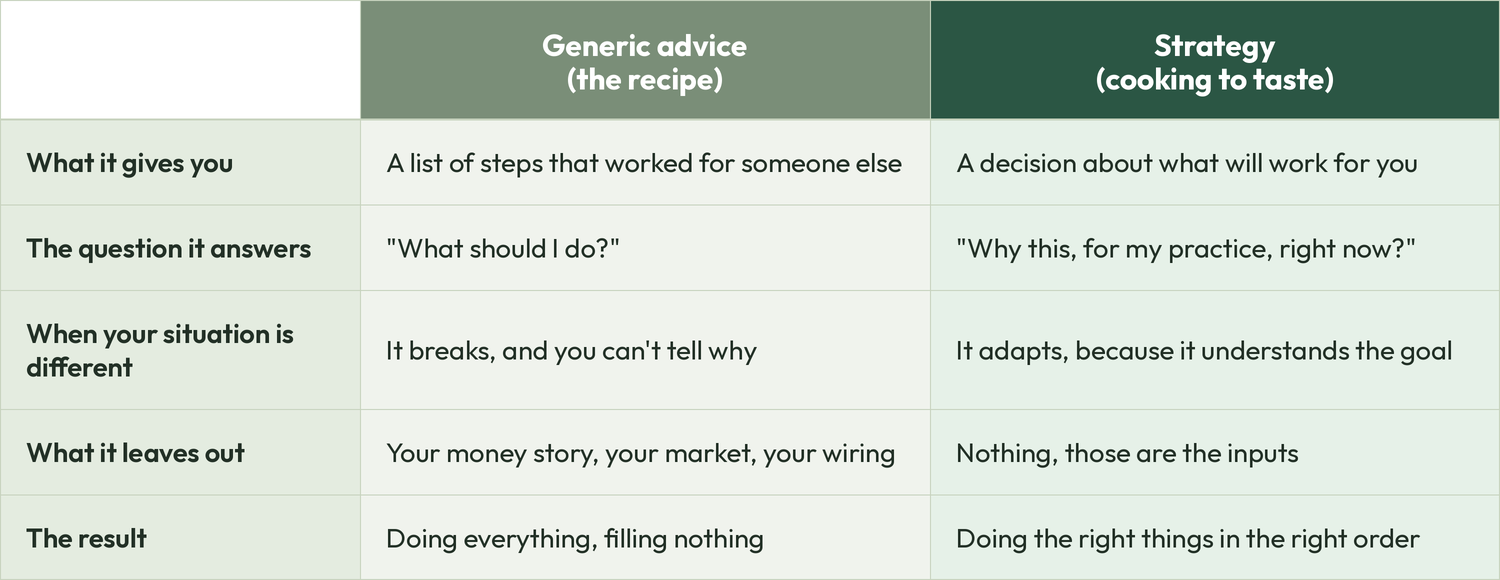
The three layers generic advice can't see
When someone hands you a marketing tactic, they're looking at one layer. But, building a practice that fills means seeing three at once, and holding them together.
The money layer. Your pricing, your fear of raising it, the belief about worth running underneath the whole thing. Advice says "charge more." It cannot see why you won't. A rate set from fear looks identical to a rate set from math until you go looking for the reason behind the number.
The market layer. Who you serve, what they type into Google at eleven at night, why they'd choose you over the therapist three doors down. Advice says "niche down." It cannot tell you which niche is yours, or whether the one you picked is so wide it says nothing at all.
The “you” layer. Your energy, the way you're wired, the model and hours you can sustain without burning to the ground. Advice says "post every day." It cannot tell you that a plan you can't keep is worse than a smaller one you can.Cooking to taste is seeing all three layers on the same plate, noticing how they change each other, and knowing what they could become together. That's the part no downloadable checklist will ever do for you.
What marketing strategy looks like in a real practice
Someone comes to me having done all the right things. Website, up. Niche, chosen. Content, posting. Booked solid? Not close. And nine times out of ten, when I look, it's the same kind of problem hiding in plain sight.
The website talks about them, their training and their modalities, instead of to the person sitting in the dark deciding whether to reach out. The niche is so broad it lands on no one or so tight that their actual consumer-base is impossible to sustain on. The fee got set from fear instead of math. Every ingredient was on the counter, but they had no idea how to put it together.
Fix the glaring thing, point the tactics they already had at something real, and the same marketing that was going nowhere starts working. They didn't need more. They just needed it structured and crafted in a way that actually gets results.
That's the whole job. Not handing you another recipe, but standing far enough back to see the thing you can't, because you've been standing on top of it for months and you have no training in it.
Do you have a tactics problem or a strategy problem?
Quick gut check. If your instinct when things stall is to add something — another platform, another freebie, another posting streak, and the needle still won't move, more tactics are not the answer. The tell is simple. Look at everything you're currently doing to market your practice and ask yourself with each one, "why is this supposed to work?" If you can't answer, that's the gap.
This is the exact thing a strategy session is built for. The 90-minute strategy consult opens with an audit of your website and socials, because that's almost always where the glaring thing is hiding, and then we build the plan that fits your practice instead of someone else's.
So before you download one more freebie or start one more posting challenge, sit with this. Of everything you're doing to fill your practice right now, how much of it can you explain the why behind, and how much are you just following the recipe?
Frequently asked questions
Why isn't my private practice marketing working even though I'm doing everything?
Because doing everything and doing it right are not the same thing. Most therapists assemble a stack of tactics from free advice built for other people's practices, without the strategy that decides which tactics matter and why. The effort is real. It's just aimed at the wrong target, or at no target at all.
What's the difference between marketing strategy and tactics for therapists?
Tactics are the individual actions, your website, blog, niche statement, or social posts. Strategy is the decision layer above them: which of those actions to run, in what order, for which clients, and why. Tactics without strategy is a pile of ingredients with no recipe and no cook.
Do I need a marketing strategy if I already have a niche and a website?
A niche and a website are tactics, not a strategy. The question is whether they were chosen on purpose, pointed at a specific person, and built to work together. Plenty of practices have both and still sit empty because nothing behind them was decided with intention.
How do I know if I have a strategy problem or just need more marketing?
Look at what you're already doing and try to explain why each piece is supposed to work. If you can't, adding more won't help, you'll just have more things you can't explain. A strategy problem hides behind the urge to keep adding.
Can I learn to think strategically about my own marketing?
Yes, the same way anyone learns to cook to taste, by understanding why things work rather than memorizing steps. It's faster with someone who already sees all three layers and can show you the glaring thing you're too close to spot, which is what a strategy consult is for.
What does a private practice strategy consultation actually do?
It starts by auditing what you've already built, your website and your online presence, finds the highest-leverage problem, and hands you a plan sequenced for your practice, your market, and the way you work. Less doing more. More doing the right things in order.